
In many situations, especially when storing or shipping fragile items, protecting them is critical. In shipping, it is quite common to encounter impact. If this impact is not absorbed, the item in the box may be damaged. That’s where polyurethane foam comes in. The use of PU foam is also common in the automotive, construction, and furniture industries. In this comprehensive guide, you can learn how polyurethane foam is manufactured and customized.
Overview of Polyurethane Foam
Polyurethane foam is a flexible, lightweight, and cellular plastic material produced through exothermic chemical reactions. This reaction occurs between two crucial compounds: polyols and diisocyanates. When you mix these elements together, they react to form a rigid, soft structural foam with tiny air-bubble gaps. It typically contains two phases. A solid phase formed by a polyurethane elastomer and a gaseous phase that contains air made by blowing agents.
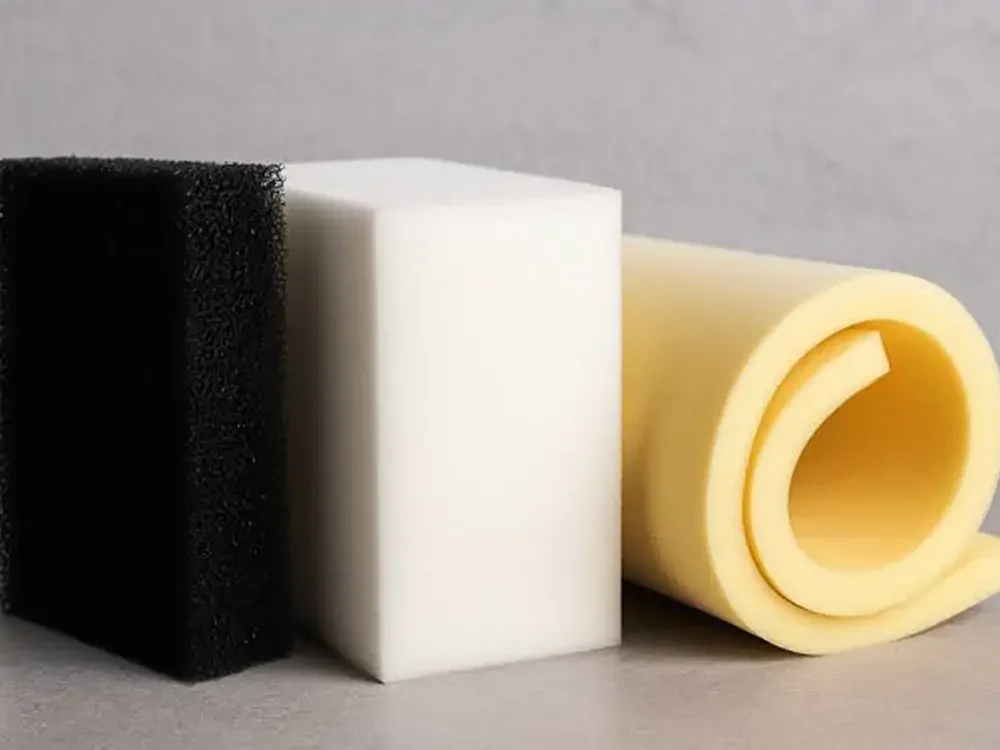
In terms of types, there are generally two: open-cell and closed-cell foam. You may already guess what open cell does. Well, it interconnects with bubbles, letting air flow smoothly through and making it soft and springy. On the other hand, closed-cell does the opposite. It traps the gas inside the bubbles, which makes it stiff, strong, and waterproof as well.
Polyurethane foam manufacturing has wide applications across various sectors and is used worldwide. However, its application also depends on the type of polyurethane foam you use. Open-cell polyurethane foams are ideal for everyday use in comfort products such as car seats, mattresses, and couch cushions. Closed-cell foams are perfect for making building insulation and safe packaging. From automotive to medical, electronics, you can find its application in every industry.
In short, polyurethane foams are highly versatile and safe for use. It can be soft or hard, depending on the chemical formula. It helps to shape our daily comfort and protects our homes.
Properties of Polyurethane Foam
Polyurethane foams have significant properties that make them worth using. In the following, we have categorized these properties into five types.
- Physical Properties: Polyurethane foam has unique physical properties. They are lightweight as they consist mostly of trapped gas. Also, its low density makes it suitable for transport and installation for various applications. As mentioned before, it can also be soft or rigid depending on the chemical composition.
- Mechanical Properties: Polyurethane foam has tensile strength and is resistant to tearing. Its building quality allows it to endure repeated compression without breaking. This foam can also easily resist impacts and structural loads.
- Thermal Properties: Generally, rigid polyurethane foams are popular for thermal insulation. This material has the lowest thermal insulation values among various insulation materials. Here, the closed cells trap insulating gases and effectively block heat transfer.
- Chemical Properties: It can resist oils, chemicals, and other solvents. When it’s rigid, the inside has high inertia. Anyway, if you keep it exposed to UV rays for a long time, the quality might degrade. For flame resistance, you can use fire-retardant elements.
- Acoustic Properties: PU foams are used to reduce noise and vibration. The open-cell performs better for sound absorption than the closed-cell. So, make sure to choose the right one for your application.
Raw Materials used in Polyurethane Foam Production
There are different types and compositions of polyurethane foam. The properties of PU foam are largely determined by the raw materials. Here, each ingredient serves a specific purpose. It influences the polymer structure. It also controls the foam expansion and curing. The following 6 raw materials are widely used in polyurethane foam manufacturing.
Polyol
Polyol is a crucial chemical compound that acts as the backbone of PU foam. It’s a complex liquid that consists of hydroxyl groups. This liquid directly reacts with diisocyanate to form a polymer. It determines whether the foam is flexible or rigid.
Diisocyanate
Diisocyanates are highly reactive. They react with polyols to form a urethane structure. TDI and MDI are the most common types. TDI suits flexible foams, and MDI is ideal for rigid ones.
Blowing Agents
Blowing agents help to create gas bubbles inside the foam. Water is a commonly used chemical blowing agent that reacts with isocyanate to generate CO₂ gas, forming the cellular structure.
Surfactants
Surfactants are mostly silicone-based. They stabilize the liquid foam by lowering its surface tension. They control cell size and uniformity. Without this ingredient, cells might collapse or merge.
Catalysts
Amine catalysts generally balance and accelerate the blowing reaction (gas generation), while tin catalysts primarily promote the gelling reaction (polymer chain linkage). Always use the right balance of catalyst. They affect foam quality and processing time.
Cross-linkers
Cross-linkers are vital for polyurethane foam manufacturing. They interconnect separate polymer chains together. This way, it improves the overall structural strength, firmness, and durability of the cured foam.
Other Additives
Adding other additives depends on the specific use of the end foam. These additives can be flame retardant, colorants, anti-microbial, and so on. You may also use UV stabilizers to protect from sunlight.
How is Polyurethane Foam Manufactured
There is no single way to manufacture polyurethane foam. The production method often depends on the shape, properties, and intended use of the final product. Before foaming begins, you must carefully prepare the polymer system. From there, you can use different processing methods to produce the foam. The exact method depends on the specific application requirements.
Polymer System Preparation
Before you start the production, prepare all the raw materials. It is a critical step. Blend the polyol with the surfactant, catalyst, and other additives, depending on the foam type. Separate the isocyanate in another area. Heat the materials to a precise temperature. Then, you have to meter and mix them with exact ratios. Thus, proper preparation will help you produce strong, uniform-quality foam.
Slabstock Foam
Slabstock foam is a common and continuous polyurethane foam manufacturing process. After mixing the chemical liquids, workers pour them onto a moving belt. The liquid expands rapidly as it moves down the line, rising into a long, continuous block of foam. Thereafter, the continuous foam loaf is cut into smaller blocks using specialized saws and left to cure for up to 72 hours.

Molded Foam
Molded foam production is a discontinuous, precise process for manufacturing polyurethane foam. In this process, the liquid chemical mixture is poured into a pre-heated, closed metal mold cavity. Then, it expands rapidly, taking the exact shape of the mold. This way, molded foam can produce consistently uniform foam with smooth outer skins. You may find its application in complex-shaped foam in the automotive industry.

Lamination
Lamination is the process of bonding polyurethane foam directly with other facing materials, such as aluminum foil, kraft paper, or fiberglass. During production, the reactive chemical mixture is dispensed between two continuously moving facings on a conveyor. As the foam expands, it adheres firmly to both surfaces simultaneously. This process creates high-strength, rigid sandwich panels that are widely used for thermal insulation in the construction and industrial refrigeration sectors.
Spraying
Spraying is an effective on-site manufacturing method. Using two elements at the gun tip, both react immediately upon contact and directly apply to the foam surface. Surfaces could be walls and roofs. Foams rapidly expand and adhere to surfaces, allowing them to fill cracks, gaps, or irregular surface structures. Despite expanding rapidly, it also cures quickly and creates seamless layers.
Customizing Polyurethane Foam for Diverse Applications
One of the key benefits of PU foam is its ability to customize for different uses. You can adjust various properties to achieve the desired performance. Although many factors can influence final foam properties, the following are among the most common parameters.
Density
Density is the mass per unit volume. In PU foam, a higher density typically means more material and less gas space, which leads to higher structural load capacity. The right choice depends on the application loads and performance requirements.
Flow & Speed of Cure
Liquid flow and cure speed depend on the catalyst you use. Fast curing is suitable for quick molding cycles. While slow curing and liquid flow speed are suitable for large and complex mold shapes, they allow the liquid to fill the mold completely.
Fire retardants
Fire retardants are used to meet safety standards. They slow the ignition, and the flame spreads. Here, manufacturers use both reactive and additive elements. Choose the right element according to your fire ratings.
Closed Cells or Open Cells?
You can customize your PU foam by using the right surfactant. It determines whether the foam is closed- or open-cell. Closed cells trap gases, making them ideal for thermal insulation. Open cells allow gas to pass, perfect for soft cushions.
Summary
Polyurethane foam is a versatile material used across many industries. You can control its performance by customizing the raw materials and additives. The polyurethane foam manufacturing is highly customizable. You can customize properties such as density, curing behavior, fire resistance, and cell structure.
You might need PU foam for packaging, furniture, automotive components, or whatever else; a single type of PU foam is not enough. That’s where understanding the polyurethane foam manufacturing is critical. If you have any questions, feel free to reach out to our customer support team.
Polyurethane foam release agent plays a crucial role in PU foam manufacturing. Amino Release agents offer a wide range of PU foam release agents. There are different types that fit into various forms of polyurethane manufacturing. Contact us today.